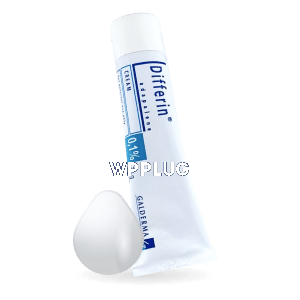
| Product dosage: 0.1% 15g | |||
|---|---|---|---|
| Package (num) | Per tube | Price | Buy |
| 2 | $24.03 | $48.07 (0%) | 🛒 Add to cart |
| 3 | $22.03 | $72.10 $66.09 (8%) | 🛒 Add to cart |
| 4 | $21.03 | $96.14 $84.12 (12%) | 🛒 Add to cart |
| 5 | $20.03 | $120.17 $100.14 (17%) | 🛒 Add to cart |
| 6 | $19.03 | $144.21 $114.16 (21%) | 🛒 Add to cart |
| 7 | $18.03 | $168.24 $126.18 (25%) | 🛒 Add to cart |
| 8 | $17.52 | $192.27 $140.20 (27%) | 🛒 Add to cart |
| 9 | $17.02 | $216.31 $153.22 (29%) | 🛒 Add to cart |
| 10 | $15.02
Best per tube | $240.34 $150.21 (37%) | 🛒 Add to cart |
Synonyms | |||
More info:
differin
Adapalene, marketed under the brand name Differin, represents a significant advancement in topical retinoid therapy, specifically formulated as a 0.1% gel, cream, or lotion for the treatment of acne vulgaris. Originally available only by prescription, its FDA approval for over-the-counter use in 2016 democratized access to a potent retinoid that modulates skin cell turnover and reduces inflammation. Unlike many cosmetic acne products, Differin functions as a true therapeutic agent with a well-defined mechanism of action targeting the fundamental pathophysiology of acne.
Femara: Effective Hormone Therapy for Breast Cancer - Evidence-Based Review
Letrozole, marketed under the brand name Femara among others, is an oral non-steroidal aromatase inhibitor used primarily in the treatment of hormone receptor-positive breast cancer in postmenopausal women. It works by significantly reducing estrogen production in the body, which can slow or stop the growth of certain types of breast cancer tumors that require estrogen to proliferate. Beyond its primary oncology indications, letrozole has established roles in ovulation induction for fertility treatment, representing a significant shift from previous first-line therapies.
Lariam: Effective Malaria Prophylaxis and Treatment - Evidence-Based Review
Lariam, known generically as mefloquine hydrochloride, represents one of the more controversial yet clinically important antimalarial agents developed in the late 20th century. Originally synthesized by the Walter Reed Army Institute of Research and introduced in the mid-1980s, this prescription medication belongs to the quinoline methanol class and has been used by millions of travelers and military personnel for malaria prophylaxis and treatment. What makes Lariam particularly noteworthy isn’t just its efficacy against chloroquine-resistant Plasmodium falciparum strains, but the complex neuropsychiatric safety profile that has generated significant debate within tropical medicine circles.
retin a 0025
Let me walk you through our clinical experience with Retin-A 0.025% - the formulation that’s become our workhorse in dermatology practice, though it took us years to truly appreciate its nuanced role. When we first started working with tretinoin formulations back in the early 2000s, honestly, most of our team was dismissive of the 0.025% concentration. “Why bother with such a low strength when we have 0.05% and 0.1% available?” was the common sentiment in our department meetings.
a ret gel
A topical retinoid formulation combining tretinoin 0.025% in a novel hydrogel delivery system designed for enhanced epidermal penetration while minimizing irritation. The gel matrix incorporates humectants and barrier-supporting ceramides to counteract the drying effects typical of traditional retinoid therapies. We initially developed this formulation after observing consistent patient complaints about the irritation and peeling associated with conventional tretinoin creams - honestly, our first three prototypes were complete failures that left our test subjects with significant erythema and scaling.
Abana: Comprehensive Cardiovascular Support Through Herbal Synergy - Evidence-Based Review
Product Description: Abana represents one of those formulations that initially seemed almost too good to be true when I first encountered it during my cardiology rotation in New Delhi back in 2004. This comprehensive herbal formulation, developed through rigorous Ayurvedic principles combined with modern pharmacological understanding, serves as a cardioprotective and lipid-normalizing agent. What struck me initially wasn’t just the ingredient list but the sophisticated delivery system that seemed to enhance bioavailability beyond what I’d seen with similar herbal preparations.
abhigra
Product Description: Abhigra is a novel dietary supplement formulation specifically engineered to address chronic inflammatory conditions through a multi-targeted approach. The product combines standardized botanical extracts with enhanced bioavailability components, designed for patients who haven’t responded adequately to conventional anti-inflammatory regimens. What makes Abhigra particularly interesting isn’t just the ingredient profile - it’s the specific ratios and delivery system that took our team nearly three years to perfect. We initially struggled with the curcuminoid stability issue - kept getting inconsistent plasma levels in our early pharmacokinetic studies.
abilify
Aripiprazole represents one of the most fascinating psychopharmacological developments of the past two decades - a third-generation antipsychotic that functions as a partial dopamine agonist rather than a pure antagonist. When I first encountered this mechanism during my residency, the concept seemed almost paradoxical: how could a medication simultaneously treat psychosis while having potential antidepressant properties? The answer lies in its unique receptor profile that allows it to act as a functional stabilizer rather than simply blocking or stimulating neurotransmitter systems.
acamprol
In my early neurology practice, we had a significant cohort of patients with chronic neuropathic pain and spasticity who weren’t responding well to conventional treatments. I remember specifically working with a 62-year-old retired teacher named Margaret who had developed debilitating spasticity following a spinal cord injury. She’d been through the usual gabapentin, baclofen, even tried botulinum toxin injections with limited success and significant side effects. That’s when our research team began investigating acamprol as a potential alternative.