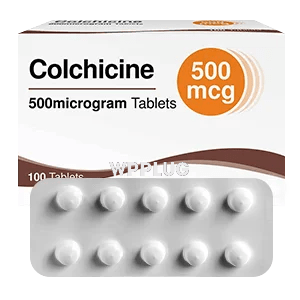
| Product dosage: 0.5mg | |||
|---|---|---|---|
| Package (num) | Per pill | Price | Buy |
| 60 | $0.95 | $57.08 (0%) | 🛒 Add to cart |
| 90 | $0.79 | $85.62 $71.10 (17%) | 🛒 Add to cart |
| 120 | $0.70 | $114.16 $84.12 (26%) | 🛒 Add to cart |
| 180 | $0.62 | $171.24 $112.16 (35%) | 🛒 Add to cart |
| 270 | $0.56 | $256.87 $152.22 (41%) | 🛒 Add to cart |
| 360 | $0.54
Best per pill | $342.49 $193.28 (44%) | 🛒 Add to cart |
Synonyms | |||
More info:
Colchicine: Targeted Anti-Inflammatory Action for Multiple Conditions - Evidence-Based Review
Colchicine is a naturally occurring alkaloid derived from the autumn crocus (Colchicum autumnale) and Gloriosa superba plants. This ancient remedy has been used for centuries to treat acute gout flares, but modern research has revealed surprising applications across multiple inflammatory conditions. What’s fascinating is how this old medication keeps finding new life in contemporary medicine - from pericarditis to familial Mediterranean fever, we’re constantly discovering new dimensions to its therapeutic potential.
allopurinol
Allopurinol is a xanthine oxidase inhibitor, a medication primarily used to manage chronic hyperuricemia and prevent gout flares and uric acid nephrolithiasis. It’s not a dietary supplement or medical device but a prescription drug with a well-established role in clinical practice. We’ve relied on it for decades to lower serum urate levels by inhibiting the enzyme responsible for uric acid production. It’s fascinating how this molecule, a purine analogue, fundamentally alters purine metabolism.
Biaxin: Effective Bacterial Infection Treatment - Evidence-Based Review
Product Description: Biaxin, known generically as clarithromycin, is a macrolide antibiotic medication prescribed primarily for bacterial infections. It works by inhibiting bacterial protein synthesis, effectively treating respiratory tract infections, skin infections, Helicobacter pylori-associated ulcers, and mycobacterial infections. Available in tablet and oral suspension forms, Biaxin is typically administered twice daily with food to enhance absorption and minimize gastrointestinal side effects. Its broad-spectrum activity and well-established safety profile make it a cornerstone in antimicrobial therapy.
dapsone
Dapsone, chemically known as 4,4’-diaminodiphenyl sulfone, is a synthetic sulfone antibiotic with a fascinating dual identity in medicine. Initially developed in the early 20th century, it has evolved from a tuberculosis treatment to a cornerstone therapy for several dermatological and infectious conditions. What makes dapsone particularly interesting is its immunomodulatory properties, which operate independently of its antimicrobial effects. This dual mechanism allows it to address conditions where inflammation and infection intersect, making it invaluable in managing complex cases like leprosy, dermatitis herpetiformis, and certain forms of vasculitis.
decadron
Decadron is the brand name for dexamethasone, a potent synthetic glucocorticoid corticosteroid medication. It’s been a cornerstone in our therapeutic arsenal since the 1960s, primarily used for its powerful anti-inflammatory and immunosuppressive effects across a staggering range of conditions, from severe allergic reactions to being part of combination chemotherapy regimens. What’s fascinating, and something I don’t think gets enough attention in the standard monographs, is its unique potency—dexamethasone is about 25 times more potent than hydrocortisone, which completely changes the dosing calculus and risk profile.
zyloprim
Zyloprim, known generically as allopurinol, represents one of those foundational medications we’ve used for decades yet still discover new nuances about. It’s a xanthine oxidase inhibitor, fundamentally altering uric acid metabolism. What’s fascinating isn’t just its mechanism - which we’ll explore - but how its clinical application has evolved beyond simple gout treatment. I remember when we first started using it in the 80s, the approach was much more conservative than today.
a ret gel
A topical retinoid formulation combining tretinoin 0.025% in a novel hydrogel delivery system designed for enhanced epidermal penetration while minimizing irritation. The gel matrix incorporates humectants and barrier-supporting ceramides to counteract the drying effects typical of traditional retinoid therapies. We initially developed this formulation after observing consistent patient complaints about the irritation and peeling associated with conventional tretinoin creams - honestly, our first three prototypes were complete failures that left our test subjects with significant erythema and scaling.
Abana: Comprehensive Cardiovascular Support Through Herbal Synergy - Evidence-Based Review
Product Description: Abana represents one of those formulations that initially seemed almost too good to be true when I first encountered it during my cardiology rotation in New Delhi back in 2004. This comprehensive herbal formulation, developed through rigorous Ayurvedic principles combined with modern pharmacological understanding, serves as a cardioprotective and lipid-normalizing agent. What struck me initially wasn’t just the ingredient list but the sophisticated delivery system that seemed to enhance bioavailability beyond what I’d seen with similar herbal preparations.
abhigra
Product Description: Abhigra is a novel dietary supplement formulation specifically engineered to address chronic inflammatory conditions through a multi-targeted approach. The product combines standardized botanical extracts with enhanced bioavailability components, designed for patients who haven’t responded adequately to conventional anti-inflammatory regimens. What makes Abhigra particularly interesting isn’t just the ingredient profile - it’s the specific ratios and delivery system that took our team nearly three years to perfect. We initially struggled with the curcuminoid stability issue - kept getting inconsistent plasma levels in our early pharmacokinetic studies.